English + Spanish classroom cards
A widely understood Spanish edition for newcomer support, early years, and primary classrooms.
13 US Letter pages · 62 cards · black-and-whiteDownload English–Spanish PDFFree printable teacher resource
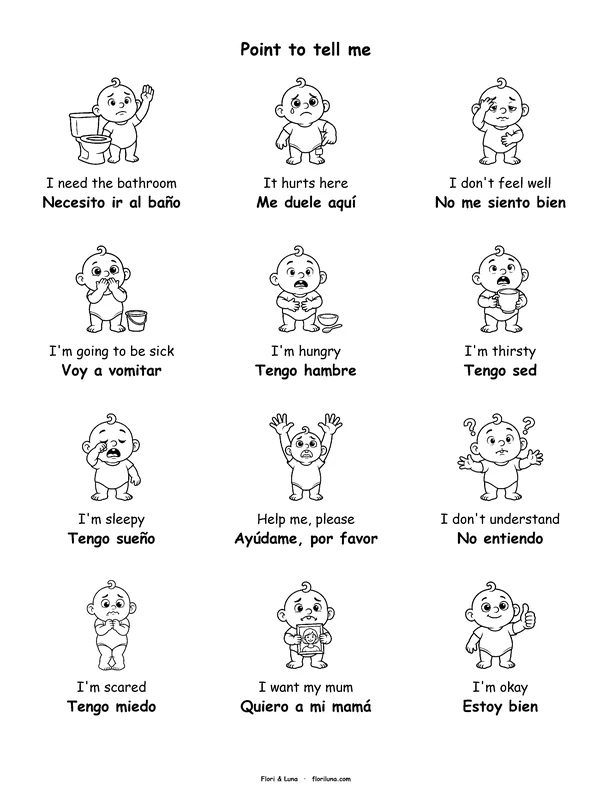
Help a child point to what they need while a new language grows. Print a ready-made board or cut out all 62 illustrated cards—no signup required.
Ready for Christmas
Download 36 ready-to-print pages for picture words, tracing, counting, picture math, I Spy, visual puzzles, four picture-bingo boards and movement breaks.
Choose a Christmas pack
Friendly autumn learning
Download 72 friendly, not-scary pages for picture bingo, group games, scavenger hunts, I Spy, visual puzzles, picture equations, pencil control, counting, picture words and storytelling.
Choose a Halloween packChoose the language families use
All ten downloads are free for personal, school, and classroom activity use.
A widely understood Spanish edition for newcomer support, early years, and primary classrooms.
13 US Letter pages · 62 cards · black-and-whiteDownload English–Spanish PDFUse this edition when your class, school, or family prefers standard Albanian wording.
13 US Letter pages · 62 cards · black-and-whiteDownload Standard Albanian PDFUse this edition when a family prefers familiar everyday Kosovo Albanian phrasing.
13 US Letter pages · 62 cards · black-and-whiteDownload Kosovo Albanian PDFClear everyday Czech for newcomer support and early-years classrooms.
13 US Letter pages · 62 cards · black-and-whiteDownload English–Czech PDFClear everyday Dutch for newcomer support and early-years classrooms.
13 US Letter pages · 62 cards · black-and-whiteDownload English–Dutch PDFClear everyday French for newcomer support and early-years classrooms.
13 US Letter pages · 62 cards · black-and-whiteDownload English–French PDFClear everyday Italian for newcomer support and early-years classrooms.
13 US Letter pages · 62 cards · black-and-whiteDownload English–Italian PDFShort, polite Korean phrases a child can point to in a new classroom.
13 US Letter pages · 62 cards · black-and-whiteDownload English–Korean PDFClear Bokmål wording for newcomer support and early-years classrooms.
13 US Letter pages · 62 cards · black-and-whiteDownload English–Norwegian PDFClear everyday Portuguese for newcomer support and early-years classrooms.
13 US Letter pages · 62 cards · black-and-whiteDownload English–Portuguese PDFNot sure which one to use? Ask the child’s family which version sounds most natural at home. Language varies by region, community, and family.
Inside the pack
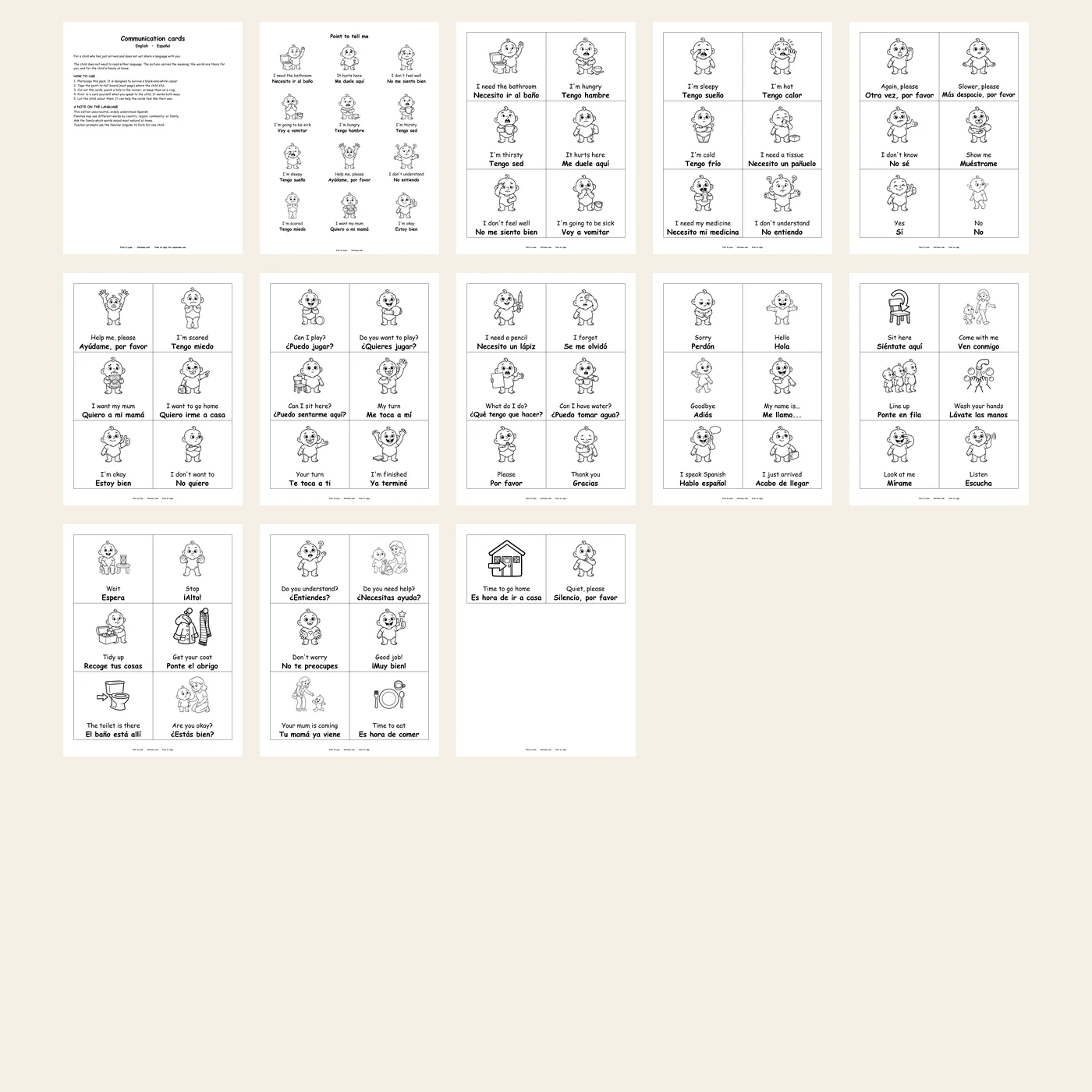
Children can point to phrases such as “I need the bathroom,” “It hurts here,” “I don’t understand,” “Can I play?”, “My turn,” “Please,” and “Thank you.”
A simple classroom routine
Keep the complete page within easy reach so a child can point without finding a loose card.
Begin with the needs and routines that matter most in your setting, then add cards gradually.
Point, say the English phrase, then the child’s home-language phrase. Invite the child to point, speak, or both.
Invite preferred words from home and keep the child’s established communication supports in use.
Teacher questions
These cards are a low-tech bridge for everyday communication. They are not a test and a child never has to speak to use them.
Report a word or request a language review →They are designed for teachers, teaching assistants, early-years settings, primary classrooms, newcomer support, and families helping a child communicate across English and one of nine family languages.
The Spanish edition uses neutral, widely understood classroom wording and the familiar singular tú form when a teacher addresses one child. Families may still prefer a different word from their country, region, or community.
Each edition has a point-to-tell board plus 62 cut-apart cards covering needs, feelings, play, classroom routines, safety, and simple social language.
Ask the family which wording sounds most natural at home. Choose Standard Albanian for the standard-language edition or Shqip (Kosovë) for familiar everyday Kosovo Albanian phrasing.
No. These are simple classroom communication supports, not an assessment or a replacement for a child’s established communication system, interpreter, safeguarding process, or professional advice.
Keep the language visible
Use the same familiar words in playful activities and bilingual books after the immediate need is understood.